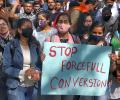
The Uttar Pradesh assembly on Tuesday passed the UP Prohibition of Unlawful Conversion of Religion (Amendment) Bill, 2024 that provides for a maximum punishment of life imprisonment, making the law stricter in cases of fraudulent or forced conversion.
Two individuals have been arrested in Muzaffarnagar, Uttar Pradesh, for allegedly carrying out unlawful religious conversions, sparking an investigation and legal proceedings.

The Maharashtra government has introduced the Maharashtra Freedom of Religion Bill 2026, which aims to prohibit religious conversions carried out through coercion, fraud, or marriage, with stringent penalties for violations.

Ayush Malik, a resident of Shamli, Uttar Pradesh, who had converted to Islam earlier this year, has now returned to Hinduism. He stated that his decision was influenced by the distress his initial conversion caused his parents. This reconversion follows a police investigation into his initial conversion under the Uttar Pradesh Prohibition of Unlawful Conversion of Religion Act, where four people have been arrested.
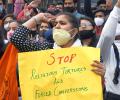
The Supreme Court has sought the Uttar Pradesh government's response on a plea challenging certain provisions of the 2024 amended UP law on unlawful religious conversion, citing concerns about free speech and religious propagation.

The Chhattisgarh government has introduced a bill aimed at preventing religious conversions through force, inducement, or misrepresentation, sparking opposition and debate in the state assembly.

Justice Renu Agarwal made the observation while rejecting a Hindu-Muslim couple's plea for police protection.

Based on a complaint from Tikaram, a resident of Sharif Nagar village in Devarniya, the case was registered under sections of the Indian Penal Code and the anti-conversion law.

The HC said this while dismissing a petition by Taufik Ahmad who had sought quashing of proceedings against him on charges of rape and unlawful religious conversion of a Hindu girl to Islam through misrepresentation under the UP anti-conversion law.

The Gujarat high court on Thursday put a stay on the operation of some sections related to interfaith marriages of the state's new anti-conversion law.

The government will introduce a bill in this regard in the upcoming legislature session, which starts on July 3.
An additional chief judicial magistrate sent the accused to nine days of police remand on Monday.

They alleged that the Uttar Pradesh Prohibition of Unlawful Conversion of Religion Ordinance was being used to "victimise especially those Indian men who are Muslim and women who dare to exercise their freedom of choice".

A 30-year-old woman with three children converted to Hinduism and married a 12th-grade student in a temple ceremony in Uttar Pradesh's Amroha district. The woman, previously known as Shabnam, has been married twice before and has no living parents. Police are reviewing the circumstances surrounding the marriage, but no legal complaints have been filed so far. The woman's previous husband was left disabled after a road accident and she obtained a divorce last week. Her new husband's father supports the marriage and wishes the couple happiness.

The Madhya Pradesh cabinet on Saturday approved the Religious Freedom Bill 2020, which provides for prison term of up to 10 years and fine of Rs 1 lakh for conversion through marriage or by any other fraudulent means, state Home Minister Narottam Mishra said.

Uttar Pradesh Police data reveals a significant increase in the number of alleged criminals killed in encounters in 2025, along with details of actions against illegal religious conversions, cow smuggling, and property recoveries.

The state cabinet presided over by Chief Minister Yogi Adityanath had earlier this week approved the draft ordinance to curb forcible or "dishonest" religious conversions including those for the sake of marriage, which could land violators in jail for up to 10 years.

Three years ago, the accused started exerting pressure on her to undergo religious conversion and perform 'nikaah' (marriage). But when the woman opposed, he threatened to kidnap her, Tikaram alleged.
The Allahabad high court, which is hearing an appeal in connection with the case, has been informed that there is no evidence that the two men tried to change the woman's religion.

The 'Karnataka Protection of Right to Freedom of Religion Bill' was passed by the Legislative Assembly in December last.
Nearly a dozen first information reports have been lodged since the Prohibition of Unlawful Conversion of Religion Ordinance, 2020, was notified on November 27.

The woman said she is an adult and married the man a few months ago of her free will. It was not immediately known whether she also changed her religion.

Amid opposition Congress's protest and walkout, the Karnataka legislative assembly on Wednesday okayed the anti-conversion bill, passed by the legislative council last week with minor amendments, that seeks to replace the ordinance that was in place to give effect to the bill.

Sarma said, "It will be mandatory for all marriages. There will be a disclosure pro forma given to a wife who'll give it to her husband. It won't be only about religion but everything that a wife needs to know. It won't be in line with Madhya Pradesh and Uttar Pradesh. It'll be empowering women."
The Karnataka cabinet on Thursday decided to promulgate an ordinance to give effect to the contentious law against religious conversions.

A prominent Islamic shrine in Bareilly has issued a decree banning religious conversion by force or allurement, endorsing Uttar Pradesh's recent ordinance aimed at curbing inter-faith marriages as an alleged ploy for conversion.
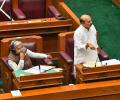
Congress partly vehemently opposed the bill, calling it "anti people", "inhuman", "anti constitutional", "anti poor" and "draconian", and urged that it should not be passed for any reason and should be withdrawn by the government.

Maulana Kaleem Siddiqui was arrested by the ATS, which is probing the racket, at around 9 pm on Tuesday from Meerut, Additional Director General (ADG), Law and Order, Prashant Kumar said.
State Congress president D K Shivakumar even tore papers on his table, in protest against the introduction of the bill, which his party called 'draconian and anti-constitution'.

'Whom do I want to marry and what decisions I make for marrying the person I love are totally personal decisions, in which neither the State nor the courts have any right to interfere.'

Making such publication mandatory would invade in the fundamental rights of liberty and privacy, the Lucknow bench of Allahabad high court said.
The Madhya Pradesh cabinet on Tuesday gave nod to an ordinance on the bill against religious conversion through fraudulent means, including those for the sake of marriage, that stipulates a jail term of up to 10 years for violators.
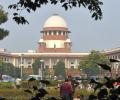
The pleas, filed by advocate Vishal Thakre and others and an NGO 'Citizens for Justice and Peace', have challenged the Constitutional validity of the Uttar Pradesh Prohibition of Unlawful Religious Conversion Ordinance, 2020 and the Uttarakhand Freedom of Religion Act, 2018 which regulate religious conversions of interfaith marriages.
The man and the woman turned out to be both Muslims and adults. Kushinagar Superintendent of Police Vinod Kumar Singh said someone from Gurnia village had informed them on Tuesday that a couple was getting 'quietly' married there, and suspected it to be a case of 'love jihad'.
A bench headed by Chief Justice S A Bobde refused, however, to stay the controversial provisions of the laws and issued notices to both state governments on two different petitions.

Kamalrukh said she is a Parsi who got married to the "Dabangg" composer under the Special Marriages Act.

The most strident criticism of UP's anti-conversion ordinance has come from the judiciary with several retired Supreme Court and high court judges having described it as being violative of Article 14 (Right to Equality), 15 (Prohibition of discrimination on grounds of religion), 21 (Right to Life) and 25 (Freedom of conscience) of the Constitution, points out Rashme Sehgal.
